
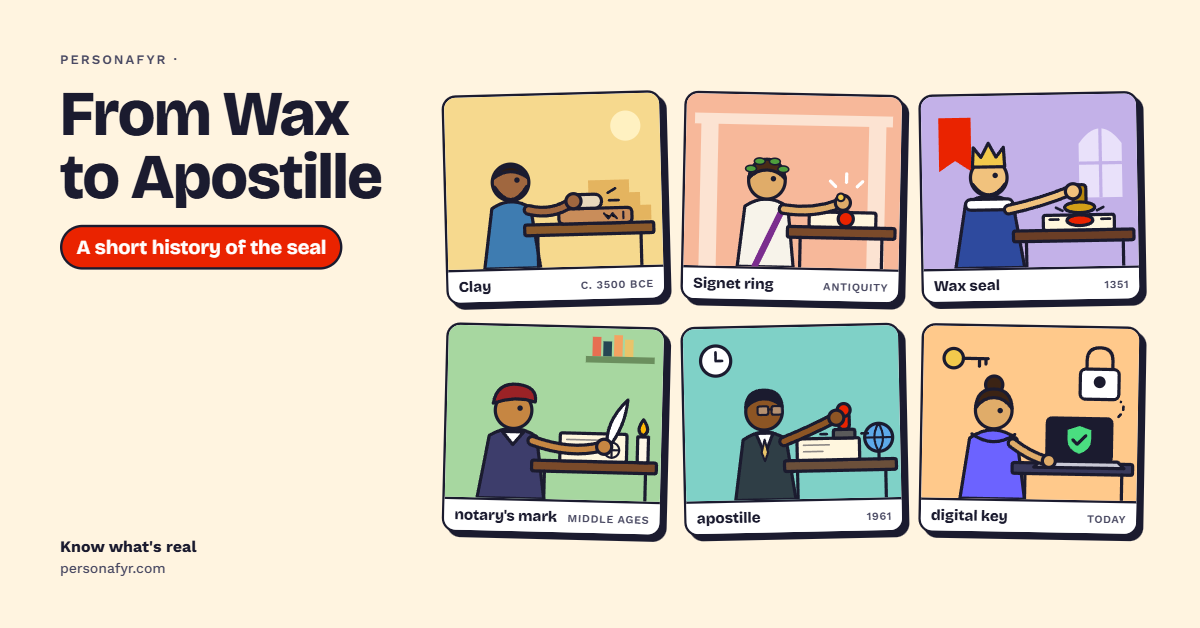
Every era has had the same problem: a message arrives, and someone has to decide whether to believe it. Did the king really order this? Did the merchant really agree to that price? Is this document what it says it is, from who it says it’s from?
For roughly five thousand years, the answer has been some version of the seal. The materials have changed from clay to wax to lead to rubber ink to code, but the idea underneath has barely moved.
Clay: the first signature
Long before most people could write, the ancient Mesopotamians were rolling small carved stone cylinders across wet clay. Each cylinder seal left a unique band of images, a miniature scene of gods, animals, or patterns that belonged to one person or one office. Pressed onto a jar stopper or a clay envelope, it said two things at once: this came from me, and no one has opened it since.
Those two jobs, identity and integrity, are still exactly what a seal does today.
The ring on your finger
As seals shrank, they moved onto the hand. Egyptian officials carried carved scarabs; Romans wore signet rings and pressed them into wax to close letters and approve contracts. The ring was the person. In the Book of Genesis, when Pharaoh raises Joseph to power, he does it by taking the signet ring off his own hand and putting it on Joseph’s. No speech required; everyone understood what had just been handed over.
That’s also why a lost or stolen signet was a crisis. Whoever held the ring could speak with your voice.
Wax, lead, and the machinery of power
By medieval Europe, the wax seal had become the backbone of government. Kings kept a Great Seal, a heavy two-sided matrix guarded by a senior official whose entire job was to control when it touched wax. Popes sealed their decrees with lead instead, a lead seal called a bulla, which is where the phrase “papal bull” comes from.
The stakes were enormous, and the law treated them that way. In England, the Treason Act of 1351 put counterfeiting the king’s seal alongside plotting his death. When a bishop or noble died, their seal matrix was often deliberately broken or defaced so no one could keep issuing documents in their name. It was the medieval equivalent of closing a dead person’s accounts.
And forgers still found a way. The most famous forged document in European history, the Donation of Constantine, a supposed grant of imperial power to the Church, circulated for centuries before the scholar Lorenzo Valla took it apart in 1440, not by examining its seal but by showing its Latin used words and phrasing that didn’t exist in Constantine’s time. The lesson has been rediscovered in every era since: a seal can be copied. What’s harder to fake is everything around it.
The notary: a person as the seal
That lesson is why the notary matters. Roman scribes called notarii recorded official business, and by the Middle Ages the notary public had become a trusted professional whose job was to witness, record, and certify. Medieval notaries even drew their own personal symbol, the signum, by hand on every document they certified, a mark as individual as a signature.
The notary’s seal was different from the king’s. It didn’t say “I command this.” It said “I, an accountable third party, watched this happen and checked who was involved.” Authority shifted from the object to the person standing behind it.
That’s still the model. In Florida, a notary’s official seal is an inked stamp carrying their name, commission number, and commission expiration date, and that stamp is only as good as the identity check and the witnessing that come before it.
The apostille: a seal for a global world
Then the world got smaller, and a new problem appeared. A notary’s seal means something in Florida. Does it mean anything in Spain? In Japan?
For a long time, the answer was a slow chain of certifications: a local official vouches for the notary, a state office vouches for the official, a foreign consulate vouches for the state, sometimes with more steps in between. Each link was another seal certifying the seal before it.
In 1961, the Hague Convention cut that chain down to a single certificate: the apostille. Among member countries, which now number more than 120, one standardized apostille from the issuing government confirms that the signature and seal on a public document are genuine. The United States joined in 1981, and here in Florida, apostilles are issued by the Department of State.
It’s a remarkably old idea in modern clothing. The apostille is essentially a seal vouching for a seal, with the trust of an entire treaty behind it.
The seal you can’t see
Today, the most important seals are invisible. When you sign a document digitally or notarize online, the “wax” is mathematics. Public-key cryptography gives each signer a private key that works much like a signet ring: only the holder can make the mark, anyone can verify it, and if it’s stolen, whoever holds it can speak in your name.
Meanwhile, the old question has come back sharper than ever. AI can now produce a convincing signature, a face, even a voice. If the mark itself can be manufactured on demand, what’s left to trust?
The answer is the one history keeps handing us. The seal was never the whole story. Clay could be carved, rings could be stolen, wax could be copied, and even a flawless-looking document could be exposed by the details around it. What made a seal trustworthy was always the system behind it: a known person, a real identity check, a witness who could be held accountable, a chain someone could follow back to the source.
The technology keeps changing. The need to prove it’s really you doesn’t.
Personafyr provides notary and apostille services in Fort Lauderdale. If you’ve got a document that needs to be trusted here or abroad, we’re happy to walk you through what it needs. Check it out -> Apostille (Legalization)
