
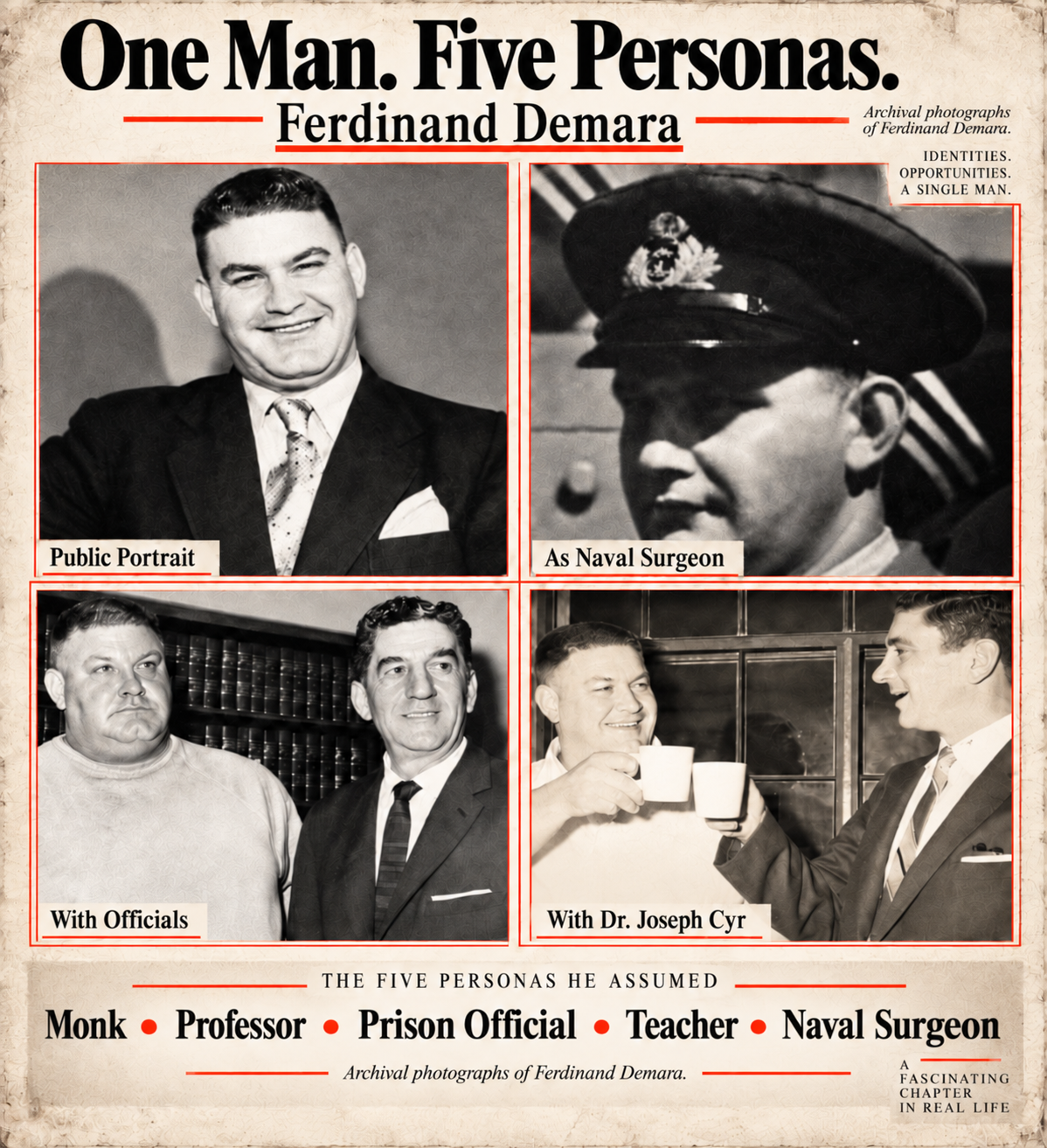
Ferdinand Demara was a monk, a professor, a prison official, a teacher, and a naval surgeon.
Different names. Different institutions. Different expectations. Same man.
Demara became known as “The Great Impostor.” But his story is more useful than a simple tale about deception.
It asks a bigger question:
How much of a person do we actually see before deciding who they are?
He stepped into personas that already existed
Demara did not invent what a monk, professor, teacher, prison official, or surgeon looked like.
Society had already done that.
Each role came with recognizable signals: clothing, titles, credentials, language, institutions, and expected behavior.
Once enough of those signals appeared together, people completed the picture.
A man in a monastery became a monk. A man at the front of a classroom became a professor. A man inside an institution of authority became an official.
Then Demara took the idea much further.
He became Dr. Joseph Cyr.
Using another physician’s identity and documents, Demara entered the Royal Canadian Navy and eventually served aboard HMCS Cayuga during the Korean War.
On paper, he was the doctor.
To the crew, he was the doctor.
But the identity behind the persona was false.
The legend became bigger than the record
Popular retellings often describe Demara studying a medical textbook, performing surgery, and saving wounded men.
The underlying event happened, but the cleaner version leaves things out.
Demara relied on medical books, experienced personnel around him, and the ship’s sick berth attendant. Accounts also differ on how many casualties he personally treated.
That does not weaken the story.
It strengthens the lesson.
Because stories build personas too.
After Demara was exposed, the persona did not disappear. It grew through newspaper stories, books, movies, and retellings.
The fake doctor became the brilliant fake doctor.
Uncertain details became confident details.
The story became easier to repeat.
And repetition began to look like proof.
Repetition is not verification
Ten websites repeating the same claim can feel like ten confirmations.
But what if nine copied the first?
Then you do not have ten sources.
You have one source wearing ten different outfits.
The same thing happens with people.
One person believes someone. Another sees that confidence. A third sees both of them.
Soon the question changes from “Is this true?” to “How could everyone be wrong?”
That is how a persona compounds.
Demara didn’t become five people
He entered five personas that already existed.
The institution provided the setting. The title provided authority. The documents provided legitimacy. Other people’s reactions provided social proof. Demara supplied enough of the expected behavior to hold it together.
That is what makes impostors useful to study.
They show us which signals we normally mistake for proof.
Looking like one, sounding like one, working where one works, carrying the right documents, and being treated like one are all powerful signals.
But none of them necessarily means:
Actually is one.
We often treat those things as if they are interchangeable.
They are not.
The uniforms changed
Today, the signal might not be a uniform.
It might be a profile, company logo, follower count, professional headline, verified badge, domain name, review, photograph, or confident AI answer.
The technology changed.
The shortcut did not.
We still see pieces, then construct the whole.
That does not mean we should distrust everyone.
It means we should understand why something feels trustworthy.
What signal caused the conclusion?
And when the stakes are high, what stronger evidence exists behind it?
Demara became famous for pretending to be other people.
But the more useful question is not how he fooled everyone.
It is:
What did everyone else see that made the persona complete?
An impostor does not create trust from nothing.
They borrow the signals of something we already trust.
We see the signals. Then we complete the person.

Leave a Reply