
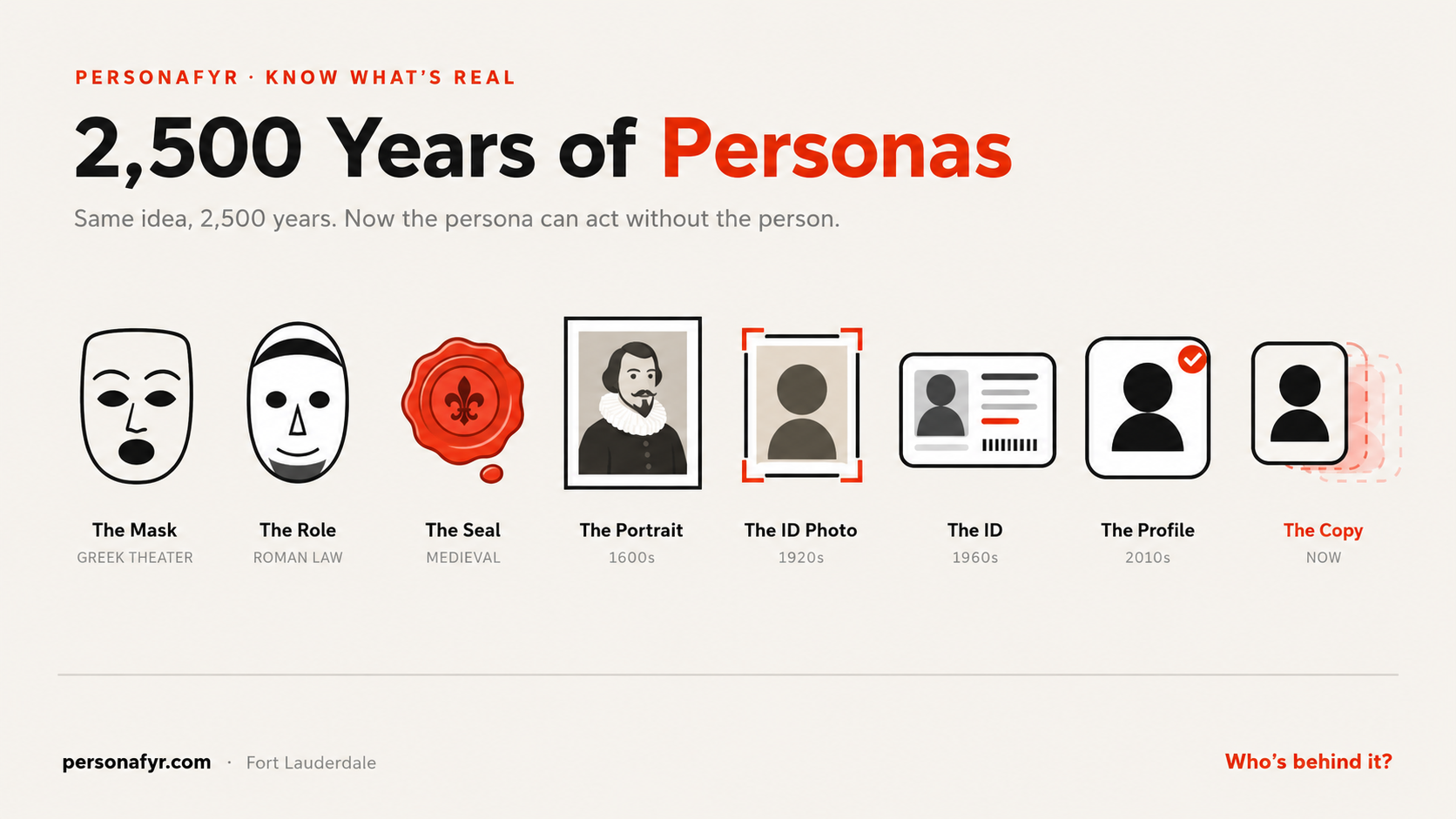
The word for the mask became the word for the person. Here’s how that happened — and why it matters now.
There is a small strangeness sitting in the middle of the English language that almost nobody notices.
The word person — the word we use for a human being, the most real thing there is — comes from a word that once referred to a mask, character, or role.
Not just a metaphorical mask. Ancient theater used actual faces presented to an audience so people could tell which character was being played.
Somewhere over about two thousand years, the language of what was presented outward became the language of the individual underneath it.
That reversal is the whole story.
And it turns out to be the story of how strangers learned to recognize each other.
It starts with a face
In Greek, prósōpon meant face, countenance, appearance — and eventually the theatrical mask.
Notice what it does not necessarily mean.
It doesn’t mean disguise.
It doesn’t mean lie.
It means what is presented to another person’s view.
That distinction survives the entire journey.
Latin developed the closely related persona. Its deeper origin isn’t completely settled. One possibility runs through the Etruscan phersu, a word associated with a masked figure.
You’ll also hear a more elegant explanation: per meaning through, sonare meaning to sound.
A persona, in that reading, is the thing the actor’s voice sounds through.
Ancient writers repeated the idea. Boethius discussed it.
Modern etymologists generally doubt that explanation because the linguistic history doesn’t fit cleanly.
We’re mentioning it anyway, and flagging it, because that’s the honest version.
It’s a beautiful explanation that probably isn’t true.
And those are exactly the ones worth marking.
The mask becomes the role
In Roman theater, persona meant the character the actor was portraying.
Three things in a row:
the human being → the mask → the character the audience sees
Then the word slipped.
It stopped needing a physical object.
A persona could be the part, the character, the role someone occupied.
And this is the moment that matters most:
A persona stopped being something you wore and became a position you acted from.
Which means it was never required to be false.
A king’s persona is the king, as king.
A judge’s persona is the judge, in that role.
The person underneath can be entirely real.
Cicero gets there first
In the first century BCE, Cicero laid out a Stoic idea — associated with Panaetius — that a human life contains four personae at once.
Roughly:
What you share with all rational human beings.
Your particular temperament.
The roles circumstance handed you.
And the path you deliberately chose.
Sit with that for a second, because it’s the thing people think social media invented.
You are a human being.
You are your specific personality.
You are somebody’s parent, somebody’s employee, somebody’s neighbor.
And you are whatever you decided to become.
All four are you.
None of them alone is all of you.
Two thousand years before anyone had a LinkedIn and an Instagram, people were already working out that one person can legitimately occupy several roles depending on context — and that this is not a moral failure.
Then the lawyers get involved
Roman law pushed persona somewhere else entirely.
Your status determined what you could do — what rights you held, what obligations bound you, what you were permitted to act as.
The question quietly changed shape.
It stopped being:
Who do I say I am?
And became:
Who does the system recognize me as?
That question never went away.
Your driver’s license.
Your passport.
Your professional license.
Your employee badge.
Your account login.
Every one of them is a mechanism for an institution to answer it.
They don’t contain the whole person.
They contain enough of a persona for a system to decide:
This is the person we recognize.
And then the word turns inside out
In the fourth and fifth centuries, Christian theologians needed vocabulary to distinguish ideas like nature, substance, and individual person.
Words such as prosōpon, hypostasis, persona, and substantia were pushed into increasingly precise meanings through centuries of Trinitarian and Christological debate.
Something odd happened to persona in the process.
A word that had described the face presented outward began helping describe what makes someone a distinct individual at all.
Around the early sixth century, Boethius produced the definition that would endure for centuries:
A person is an individual substance of a rational nature.
Follow the whole chain:
mask presented by a human → character represented by the mask → social role occupied → recognized individual → the human being himself
Latin persona passed through French and arrived in English as person.
And an entire family came with it.
Personal.
Personality.
Personnel.
Personify.
Impersonate.
English eventually kept both halves of the ancient idea:
Person — the actual individual.
Persona — the form that individual takes in a particular context.
Psychology brings the mask back
After centuries of person drifting toward the real human being, Carl Jung reached back and picked up the older meaning.
He used persona for the public face a person presents to the world.
For Jung, it works almost like an interface.
Inner life on one side.
Society on the other.
Persona in between.
You have a work persona.
A family persona.
A version of yourself for strangers.
None of that automatically makes any of them a lie.
Then Erving Goffman took the theatrical comparison even further in The Presentation of Self in Everyday Life.
The individual is a performer.
The social situation is a stage.
Everyone else is an audience.
Which returns the idea almost exactly to where it started.
Theater.
Then it gets stolen twice
In the late 1990s, software designers took the word again.
Through Alan Cooper’s work, a persona became a fictional character representing a type of user — a design tool.
The direction reversed.
It stopped being a role occupied by one real person and became an imaginary person standing in for many real ones.
Then the internet changed it again.
Everybody became a performer.
And the modern persona arrived with a complication the ancients never faced:
You don’t fully control it.
Your online persona is assembled from what you post — but also from what other people tag, comment, share, screenshot, search, and say.
Then a system decides which parts of it other people see.
And increasingly, systems infer things you never explicitly said at all.
So the layers stack up:
Who I am → who I present as → who others perceive → who a system predicts I am
That last layer changes the game.
Which brings us to now
For twenty-five centuries, one assumption sat underneath almost all of this:
The persona pointed back toward an operator.
When a Greek audience watched an actor, someone was behind the mask.
When a merchant received a sealed letter, someone pressed the seal.
When an institution inspected an identification document, there was supposed to be a person connected to it.
The representation pointed somewhere.
That’s the part becoming unreliable.
Identity theft isn’t new.
Neither is impersonation.
People have forged signatures, stolen documents, borrowed names, impersonated heirs, taken over accounts, and pretended to be other people for centuries.
What’s changed is the copy.
It used to take considerable work to make the persona follow the impersonator.
A document had to be forged.
An account had to be taken over.
A signature had to be copied.
A resemblance had to be convincing.
A story had to hold together.
Now the representation itself can be reproduced.
A face can be generated from nothing.
It can also be built from a real person who never agreed to it — a photo pulled from a profile, a likeness animated into video, a voice cloned from a short recording.
Your face can appear somewhere you’ve never been.
Your voice can say something you’ve never said.
A version of you can operate in several places at once while the original remains untouched.
No passport has to disappear.
No account necessarily has to be hacked.
No physical object has to change hands.
The copy can exist alongside you.
And it can multiply.
The face and the hands have come apart.
Somebody is still operating the persona.
Somebody is typing, prompting, collecting, deciding, or directing.
But the face no longer reliably tells you whose hands are behind it.
Which produces two different problems.
You can be fooled — you trust a persona that isn’t operated by who it appears to be.
And you can be copied — someone else operates a version of you.
That changes the verification question.
Is this a real person? is no longer enough.
Often the person is real.
The photograph may belong to a completely real nurse in Ohio who has no idea her face is being used in a romance scam.
The better question is:
Who is actually behind what I’m seeing?
For 2,500 years, that was the question behind the mask.
It’s the question again.
Personafyr works in verification for a living — fingerprinting, background checks, and apostille in Fort Lauderdale. We also give away free training in reading personas, because the skill is not what it used to be.
personafyr.com/training
